Demo: 1.2x1.2mm FOV
Estimating the reliable dimensionality of neuronal population dynamics as a function of neuron number
This example will walk you through a number of analyses from Manley et al. Neuron 2024. Namely:
Utilizing SVCA to estimate the reliable dimensionality of neuronal population dynamics as a function of neuron number
Predicting neural SVC dimensions from behavioral variables
Quantifying the timescales of neural SVC dimensions
Quantifying the spatial distribution of neural SVC dimensions
The data analyzed here are freely available at https://doi.org/10.5281/zenodo.10403684.
[1]:
import matplotlib.pyplot as plt
import numpy as np
import os
from rastermap import Rastermap
from scipy.stats import zscore
from tqdm import tqdm
import warnings
warnings.simplefilter("ignore")

import scaling_analysis as sa
from scaling_analysis.experiment import Experiment
from scaling_analysis.plotting import set_my_rcParams, plot_MIPs, plot_neurons_behavior, calc_var_expl
from scaling_analysis.predict import predict_from_behavior
from scaling_analysis.spatial import local_homogeneity
from scaling_analysis.temporal import compute_timescales

set_my_rcParams()
The Experiment class loads the example .h5 files provided.
[2]:
path = "/path/to/example/data/"
file = "20210311_left_1p2mm_FOV_50_550um_depth_65percent_60min_no_stim.h5"
expt = Experiment(os.path.join(path, file))
Loading example data 20210311_left_1p2mm_FOV_50_550um_depth_65percent_60min_no_stim.h5
[3]:
# z-scored neural data
neurons = zscore(expt.T_all.astype('single'))
print(file, "contains", neurons.shape[1], "neurons and", neurons.shape[0], "timepoints")

# neuron positions
centers = expt.centers

# z-scored facial videography behavior data
motion = zscore(expt.motion.astype('single')) * 10
print(file, "contains", motion.shape[1], "behavior PCs and", motion.shape[0], "timepoints")
20210311_left_1p2mm_FOV_50_550um_depth_65percent_60min_no_stim.h5 contains 6519 neurons and 34600 timepoints
20210311_left_1p2mm_FOV_50_550um_depth_65percent_60min_no_stim.h5 contains 500 behavior PCs and 34600 timepoints
[4]:
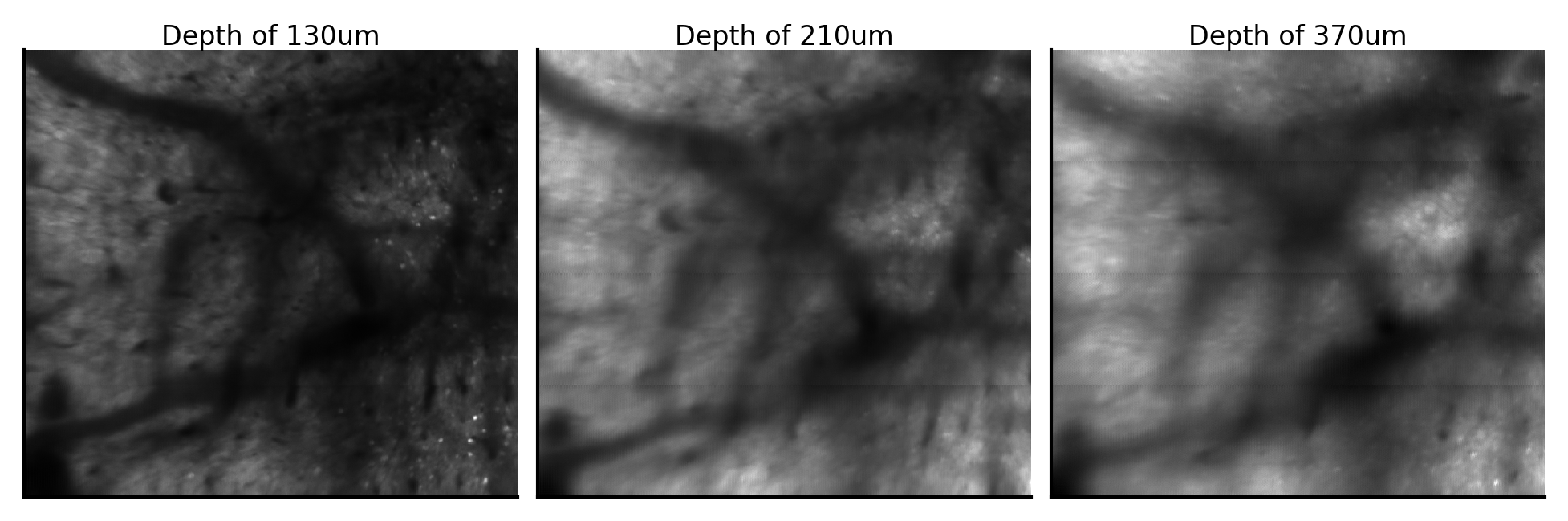
# PLOT MAXIMUM INTENSITY PROJECTIONS OF FOV

plot_MIPs(expt.Y)
[5]:
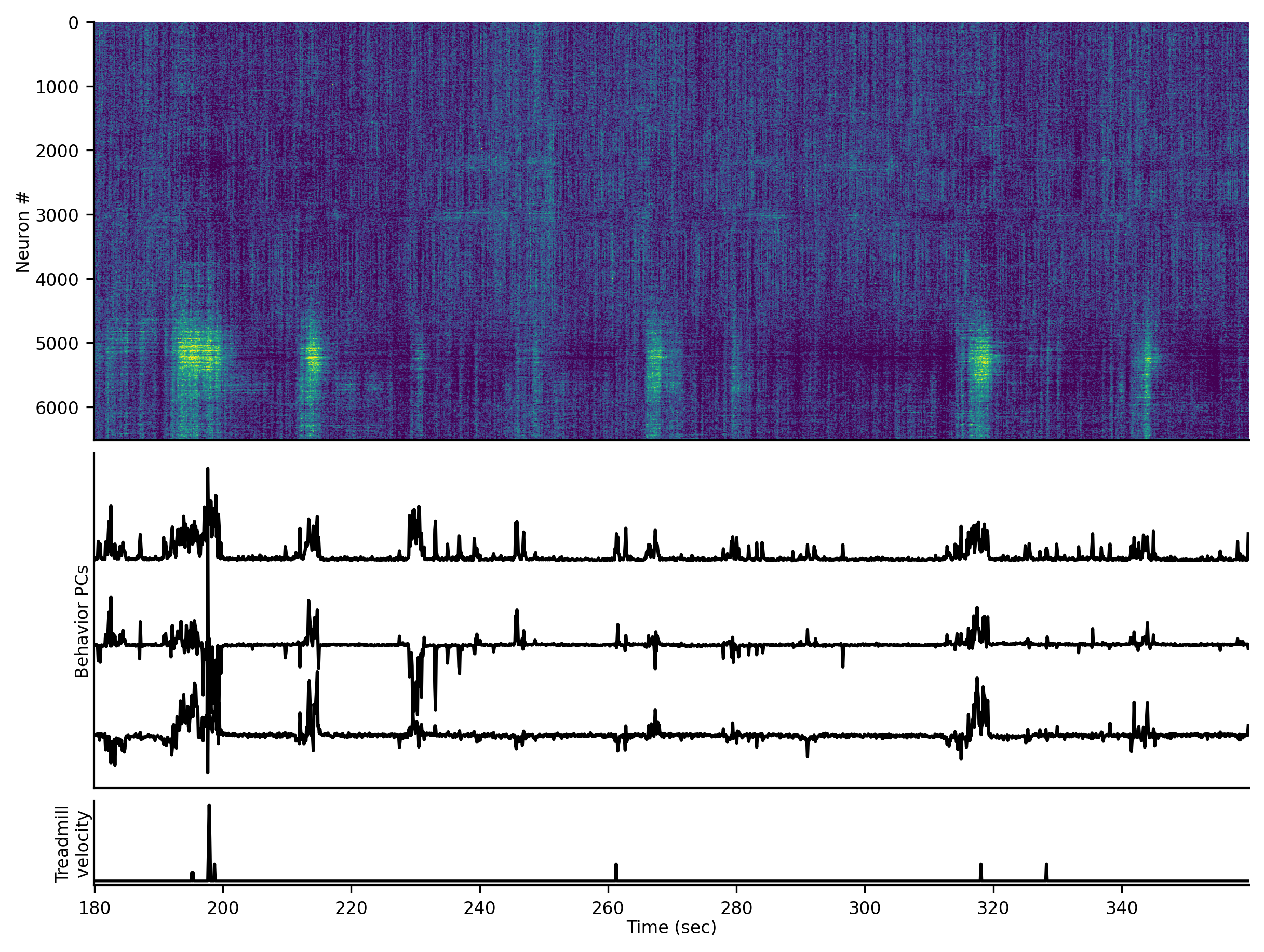
# PLOT EXAMPLE NEURAL AND BEHAVIORAL DYNAMICS

min_start = 3 # minutes
min_stop = 6 # minutes

t_idx = np.arange(int(expt.fhz * min_start * 60),
                  int(expt.fhz * min_stop * 60))

neurons_example = zscore(neurons[t_idx,:])
motion_example = zscore(motion[t_idx, :3])

model = Rastermap(n_PCs=16, n_clusters=4).fit(neurons_example.T)
normalizing data across axis=1
projecting out mean along axis=0
data normalized, 0.07sec
sorting activity: 6519 valid samples by 1729 timepoints
n_PCs = 16 computed, 6.03sec
4 clusters computed, time 6.08sec
clusters sorted, time 6.09sec
clusters upsampled, time 6.10sec
rastermap complete, time 6.10sec
[6]:
plot_neurons_behavior(neurons_example[:,model.isort], motion_example,
                      expt.velocity_events[t_idx], expt.t[t_idx]);
SVCA on varying neuron numbers
[7]:
# PARAMETERS
# Note: these analyses can take quite some time to run for large neuron numbers
# Reduce nneurs, nsamplings, nsvc, and/or nsvc_predict for smaller, efficient tests
nneurs = 2 ** np.arange(8,21)   # numbers of neurons to sample
nneurs = nneurs[nneurs <= neurons.shape[1]]
nneurs = np.concatenate((nneurs, [neurons.shape[1]]))
checkerboard = 250              # size of lateral checkerboard pattern to split neural sets, in um
nsamplings = 3                  # number of samplings to perform
lag = -1                        # lag between motion and neural data, in frames
interleave = int(72*expt.fhz)   # length of chunks that are randomly assigned to training or testing, in frames
nsvc = 512                      # number of SVCs to find
nsvc_predict = 64               # number of SVCs to predict from behavior
lams = [0.01, 0.1]              # regularization parameters for reduced rank regression of neural SVCs
ranks = np.unique(np.round(     # ranks to test in reduced rank regression of neural SVCs
    2 ** np.arange(2,8))
                 ).astype(int)

MLPregressor = False             # whether or not to fit MLP nonlinear model
prePCA = False                   # whether or not to perform PCA before running SVCA
                                 #         (saves memory for large neuron number, but takes longer)
[8]:
cov_neurs = np.zeros((len(nneurs), nsvc, nsamplings))+np.nan # reliable (co)variance
var_neurs = np.zeros((len(nneurs), nsvc, nsamplings))+np.nan # total variance
cov_res_behs = np.zeros((len(nneurs), nsvc_predict, len(ranks), len(lams), nsamplings))+np.nan # residual covariance
                                                                                               # after behavior prediction
ex_u = []
ex_v = []
ex_ntrain = []
ex_ntest = []
ex_itrain = []
ex_itest = []

for n in range(len(nneurs)):
    print(nneurs[n], 'NEURONS')
    (cov_neur, var_neur, cov_res_beh, cov_res_beh_mlp, actual_nneurs, u, v,
    ntrain, ntest, itrain, itest, pca) = \
        predict_from_behavior(neurons, nneurs[n], centers, motion, ranks, nsamplings=nsamplings, lag=lag,
                              lams=lams, nsvc=nsvc, nsvc_predict=nsvc_predict, checkerboard=checkerboard,
                              prePCA=prePCA, MLPregressor=MLPregressor, interleave=interleave)

    cov_neurs[n,:] = cov_neur
    var_neurs[n,:] = var_neur
    cov_res_behs[n,:] = cov_res_beh

    ex_u.append(u)
    ex_v.append(v)
    ex_ntrain.append(ntrain)
    ex_ntest.append(ntest)
    ex_itrain.append(itrain)
    ex_itest.append(itest)
256 NEURONS
100%|██████████| 3/3 [01:04<00:00, 21.63s/it]
512 NEURONS
100%|██████████| 3/3 [01:15<00:00, 25.29s/it]
1024 NEURONS
100%|██████████| 3/3 [01:18<00:00, 26.07s/it]
2048 NEURONS
100%|██████████| 3/3 [01:24<00:00, 28.26s/it]
4096 NEURONS
100%|██████████| 3/3 [01:33<00:00, 31.10s/it]
6519 NEURONS
100%|██████████| 3/3 [01:34<00:00, 31.52s/it]
Shuffling tests
[9]:
# Compute shuffled SVCs

nsamplings_shuff = 5 # ideally we'd want more to get a good sense
                     # of the distribution of shuffled coefficients

cov_neurs_shuff = np.zeros((nsvc, nsamplings_shuff))+np.nan
var_neurs_shuff = np.zeros((nsvc, nsamplings_shuff))+np.nan
cov_res_behs_shuff = np.zeros((nsvc_predict, len(ranks), len(lams), nsamplings_shuff))+np.nan

ex_u_shuff = []
ex_v_shuff = []
ex_ntrain_shuff = []
ex_ntest_shuff = []
ex_itrain_shuff = []
ex_itest_shuff = []

# Run predict_from_behavior many times with 1 sampling each,
# so that we save the example u, v, etc. every time we run SVCA
for i in range(nsamplings_shuff):
    print("SAMPLING", i+1, "OUT OF", nsamplings_shuff)
    (cov_neur, var_neur, cov_res_beh, cov_res_beh_mlp, actual_nneurs, u, v,
    ntrain, ntest, itrain, itest, pca) = \
        predict_from_behavior(neurons, nneurs[-1], centers, motion, ranks, nsamplings=1, lag=lag,
                              lams=lams, nsvc=nsvc, nsvc_predict=nsvc_predict, checkerboard=checkerboard,
                              prePCA=prePCA, MLPregressor=MLPregressor, interleave=interleave, shuffle=True)

    cov_neurs_shuff[:,i] = cov_neur[:,0]
    var_neurs_shuff[:,i] = var_neur[:,0]
    cov_res_behs_shuff[:,i] = cov_res_beh[:,0]

    ex_u_shuff.append(u)
    ex_v_shuff.append(v)
    ex_ntrain_shuff.append(ntrain)
    ex_ntest_shuff.append(ntest)
    ex_itrain_shuff.append(itrain)
    ex_itest_shuff.append(itest)
SAMPLING 1 OUT OF 5
100%|██████████| 1/1 [00:30<00:00, 30.15s/it]
SAMPLING 2 OUT OF 5
100%|██████████| 1/1 [00:31<00:00, 31.07s/it]
SAMPLING 3 OUT OF 5
100%|██████████| 1/1 [00:31<00:00, 31.52s/it]
SAMPLING 4 OUT OF 5
100%|██████████| 1/1 [00:28<00:00, 28.65s/it]
SAMPLING 5 OUT OF 5
100%|██████████| 1/1 [00:28<00:00, 29.00s/it]
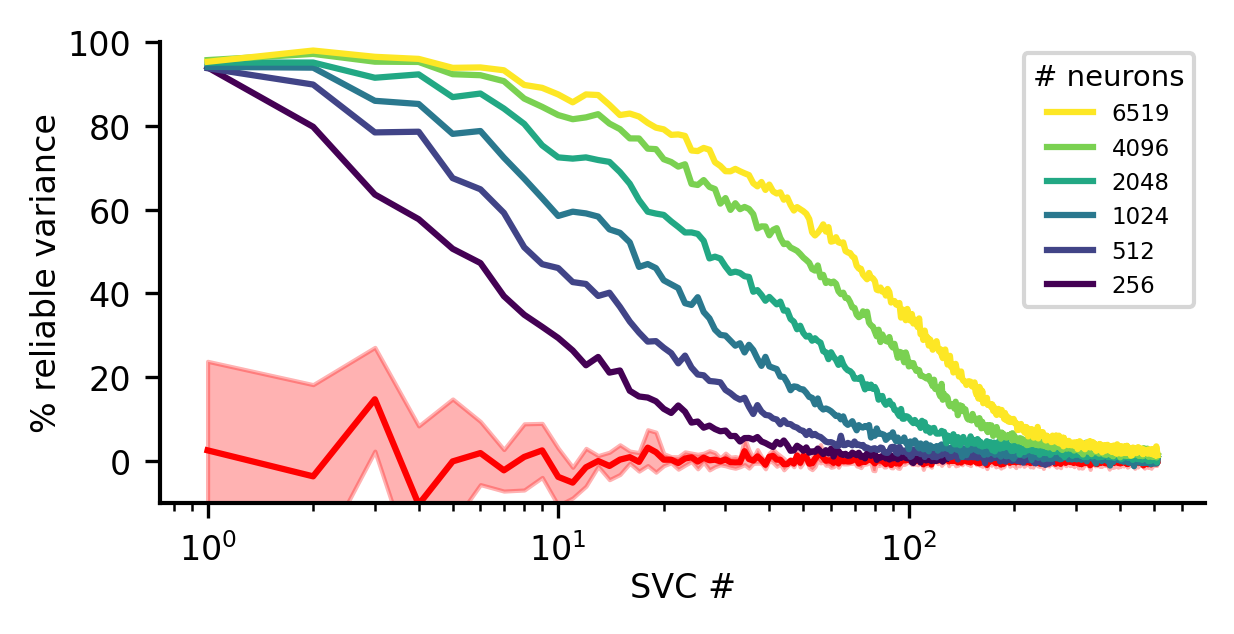
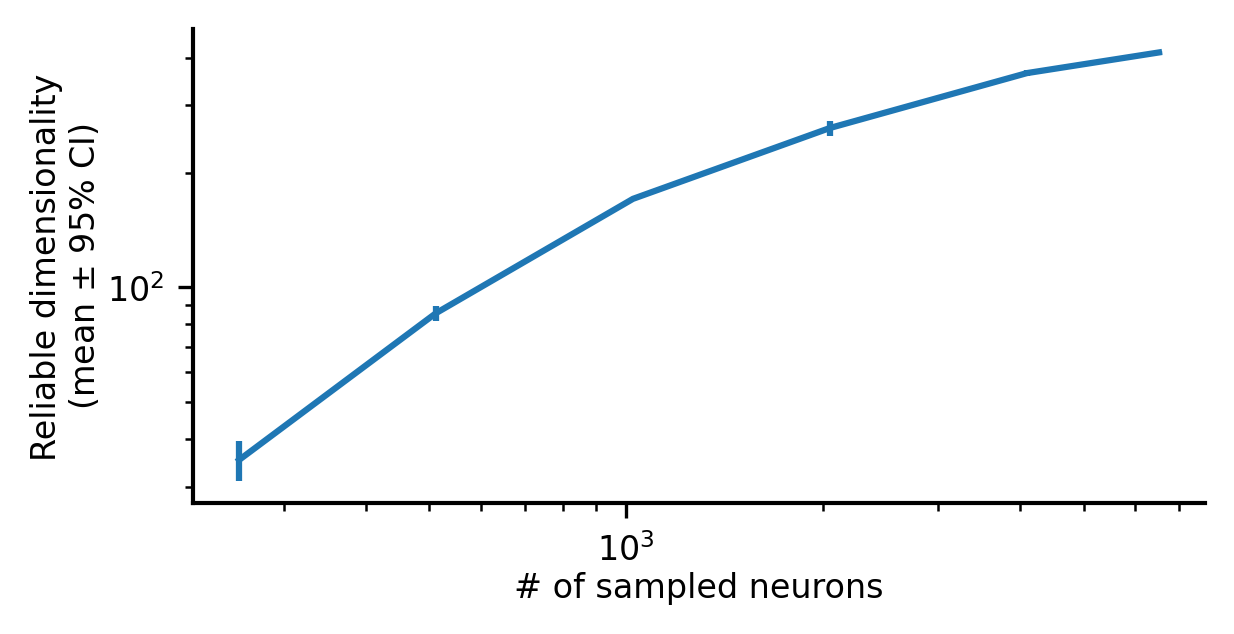
The reliable dimensionality scales in an unbounded fashion with the number of randomly sampled neurons
[10]:
# PLOT % RELIABLE VARIANCE VS. SVC # FOR EACH NEURON NUMBER

plt.figure(figsize=(4,2))
colors = plt.cm.viridis(np.linspace(0,1,len(nneurs)))
ls = []

# Plot shuffed data
relvar_shuff = np.nanmean(cov_neurs_shuff/var_neurs_shuff,axis=-1)
relvar_shuff_std = np.nanstd(cov_neurs_shuff/var_neurs_shuff,axis=-1)
l,=plt.plot(np.arange(len(relvar_shuff))+1, relvar_shuff*100, color='r')
plt.fill_between(np.arange(len(relvar_shuff))+1, (relvar_shuff - relvar_shuff_std)*100,
                 (relvar_shuff + relvar_shuff_std)*100, color='r', alpha=0.3)

# Plot data
for n in range(len(nneurs)):
    relvar = np.nanmean(cov_neurs[n,:]/var_neurs[n,:],axis=-1)
    l,=plt.plot(np.arange(len(relvar))+1, relvar*100, color=colors[n])
    ls.append(l)

plt.xlabel('SVC #')
plt.ylabel('% reliable variance')
plt.legend(np.flipud(ls), np.flipud(nneurs), title='# neurons')
plt.ylim([-10, 100])
plt.xscale('log');
[11]:
# PLOT # RELIABLE SVCS VS. NNEUR

# thresh = 0.2 # can also compare to a manual threshold
# ideally, we'd have thresholds for each neuron number
# however we only computed shuffled SVCs for the largest neuron number!
n_sigma = 4
thresh = relvar_shuff + n_sigma * relvar_shuff_std
thresh = thresh[np.newaxis,:,np.newaxis]

reldim = np.nanmean(np.nansum(cov_neurs/var_neurs>thresh,axis=1),axis=-1)
ci95 = np.nanstd(np.nansum(cov_neurs/var_neurs>thresh,axis=1),axis=-1)/np.sqrt(nsamplings)*1.96

plt.figure(figsize=(4,2))
plt.errorbar(nneurs, reldim, ci95)
plt.xscale('log')
plt.yscale('log')
plt.xlabel('# of sampled neurons')
plt.ylabel('Reliable dimensionality\n(mean $\\pm$ 95% CI)');
Predictability of neural SVCs from behavior videography
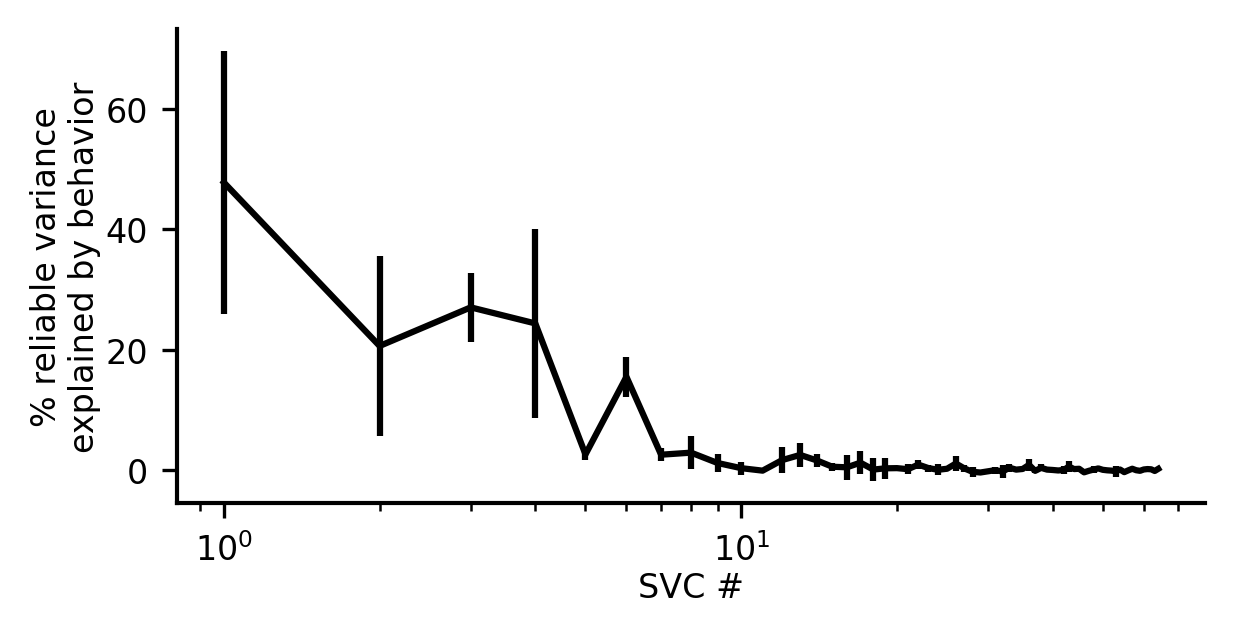
Only the few largest neural SVCs are predictable from instantaneous behavior
[12]:
# PLOT VAR. EXPL. BY BEHAVIOR VS. SVC #

varexpl_per_sampling = calc_var_expl(cov_neurs, var_neurs, cov_res_behs)
varexpl = np.nanmean(varexpl_per_sampling, axis=-1)
ci95 = np.nanstd(varexpl_per_sampling, axis=-1)/np.sqrt(nsamplings)*1.96

plt.figure(figsize=(4,2))
plt.errorbar(np.arange(nsvc_predict)+1, varexpl[-1,:]*100, ci95[-1,:]*100, color='k')
plt.xlabel('SVC #')
plt.ylabel('% reliable variance\nexplained by behavior')
plt.xscale('log');
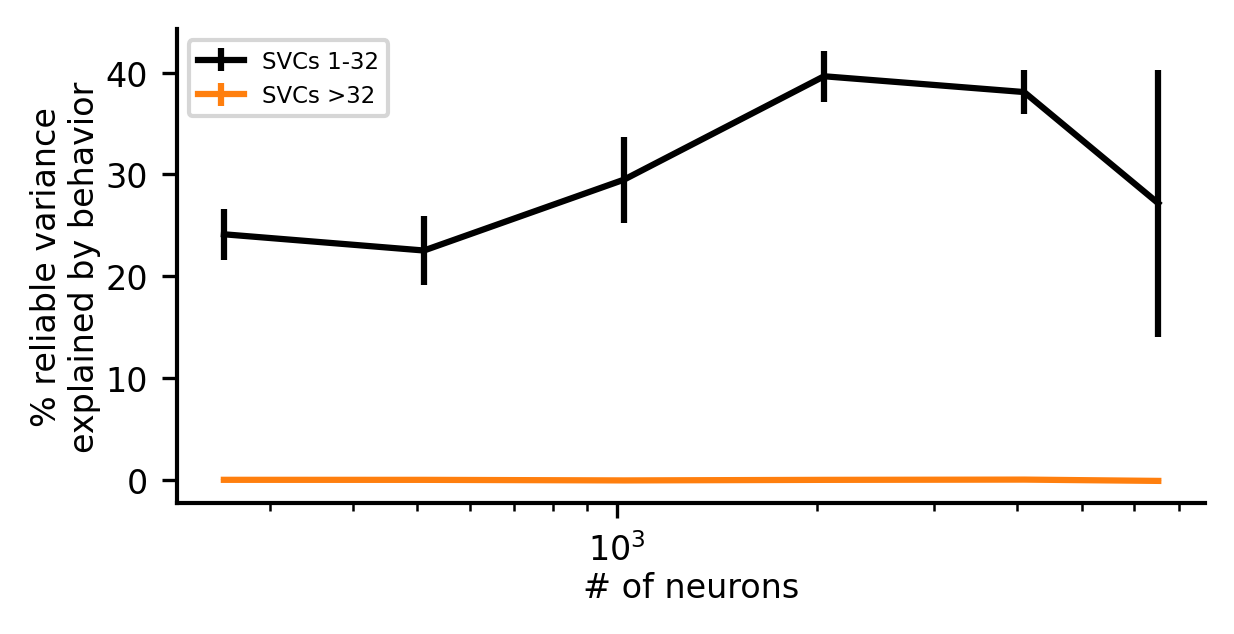
The fraction of neural variance explained by behavior saturates at ~10,000 neurons
[13]:
# PLOT VAR. EXPL. BY BEHAVIOR VS. NEURON NUMBER

low_pcs = range(32)

varexpl_per_sampling = calc_var_expl(cov_neurs[:,low_pcs,:], var_neurs[:,low_pcs,:], cov_res_behs[:,low_pcs,:], cumulative=True)
varexpl_vs_nneur_low = np.nanmean(varexpl_per_sampling, axis=-1)
ci95_low = np.nanstd(varexpl_per_sampling, axis=-1)/np.sqrt(nsamplings)*1.96

high_pcs = range(32,nsvc_predict)

varexpl_per_sampling = calc_var_expl(cov_neurs[:,high_pcs,:], var_neurs[:,high_pcs,:], cov_res_behs[:,high_pcs,:], cumulative=True)
varexpl_vs_nneur_high = np.nanmean(varexpl_per_sampling, axis=-1)
ci95_high = np.nanstd(varexpl_per_sampling, axis=-1)/np.sqrt(nsamplings)*1.96

plt.figure(figsize=(4,2))
plt.errorbar(nneurs, varexpl_vs_nneur_low[:,-1]*100, ci95_low[:,-1]*100, color='k')
plt.errorbar(nneurs, varexpl_vs_nneur_high[:,-1]*100, ci95_high[:,-1]*100, color=plt.cm.tab10(1))
plt.xscale('log')
plt.legend(['SVCs 1-32','SVCs >32'])
plt.xlabel('# of neurons')
plt.ylabel('% reliable variance\nexplained by behavior');
Autocorrelation timescales of neural SVCs
[14]:
# Compute autocorrelation timescales for each neuron number

timescales = np.zeros((nsvc, len(nneurs)))+np.nan

for i in tqdm(range(len(nneurs))):
    svcs = neurons[:,ex_ntrain[i]] @ ex_u[i]
    _, curr_timescales, _ = compute_timescales(svcs, expt.t)
    timescales[:len(curr_timescales),i] = curr_timescales
100%|██████████| 6/6 [04:52<00:00, 48.81s/it]
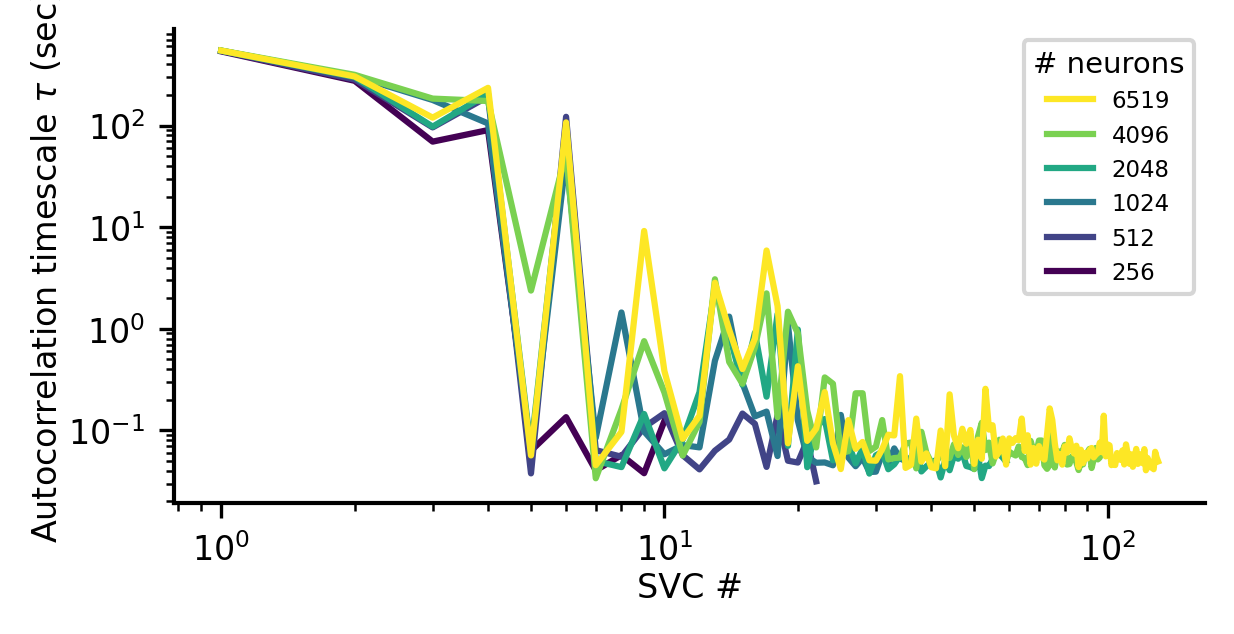
Neural SVCs exhibit a continuum of timescales
[15]:
# PLOT AUTOCORRELATION TIMESCALES VS. NEURON NUMBER

plt.figure(figsize=(4,2))
colors = plt.cm.viridis(np.linspace(0,1,len(nneurs)))
ls = []

for n in range(len(nneurs)):
    relvar = np.nanmean(cov_neurs[n,:]/var_neurs[n,:],axis=-1)
    idx_reliable = np.where(relvar > 0.25)[0]
    nplot = idx_reliable[-1]
    l,=plt.plot(np.arange(nplot)+1, timescales[:nplot,n], color=colors[n])
    ls.append(l)

plt.xlabel('SVC #')
plt.ylabel('Autocorrelation timescale $\\tau$ (sec)')
plt.legend(np.flipud(ls), np.flipud(nneurs), title='# neurons')
plt.xscale('log')
plt.yscale('log');
/var/folders/44/wxb14ysx2zg17xfp0hkwzmjm0000gn/T/ipykernel_28910/3100988667.py:8: RuntimeWarning: Mean of empty slice
  relvar = np.nanmean(cov_neurs[n,:]/var_neurs[n,:],axis=-1)
Spatial distribution of neural SVCs
[16]:
nneuri = len(nneurs)-1       # which neuron # to analyze
percentile = 0.03            # top percent of neurons considered "participating" in SVC
dists = [20,50,100,250,500]  # radial distances (um) to measure homogeneity
nspatial = 100               # number of neurons to compute their local homogeneity

u_neurnorm = np.abs(ex_u[nneuri])/np.sum(np.abs(ex_u[nneuri]), axis=1).reshape(-1,1)
idxsort = np.argsort(u_neurnorm, axis=0)
ucenters = centers[:,ex_ntrain[nneuri]]

homogeneity = np.zeros((nsvc,len(dists),nspatial))+np.nan

for i in tqdm(range(nsvc)):
    idxbig = idxsort[:,i][-int(percentile*u_neurnorm.shape[0]):]
    binary = np.zeros((u_neurnorm.shape[0],))
    binary[idxbig] = True

    curr = local_homogeneity(binary, ucenters, dist_threshes=dists, ntodo=nspatial)
    homogeneity[i,:,:curr.shape[0]] = curr.T
  0%|          | 0/512 [00:00<?, ?it/s]/Users/jmanley/Documents/miniconda3/envs/testpc/lib/python3.8/site-packages/numpy/core/fromnumeric.py:3464: RuntimeWarning: Mean of empty slice.
  return _methods._mean(a, axis=axis, dtype=dtype,
/Users/jmanley/Documents/miniconda3/envs/testpc/lib/python3.8/site-packages/numpy/core/_methods.py:192: RuntimeWarning: invalid value encountered in scalar divide
  ret = ret.dtype.type(ret / rcount)
100%|██████████| 512/512 [00:01<00:00, 294.78it/s]
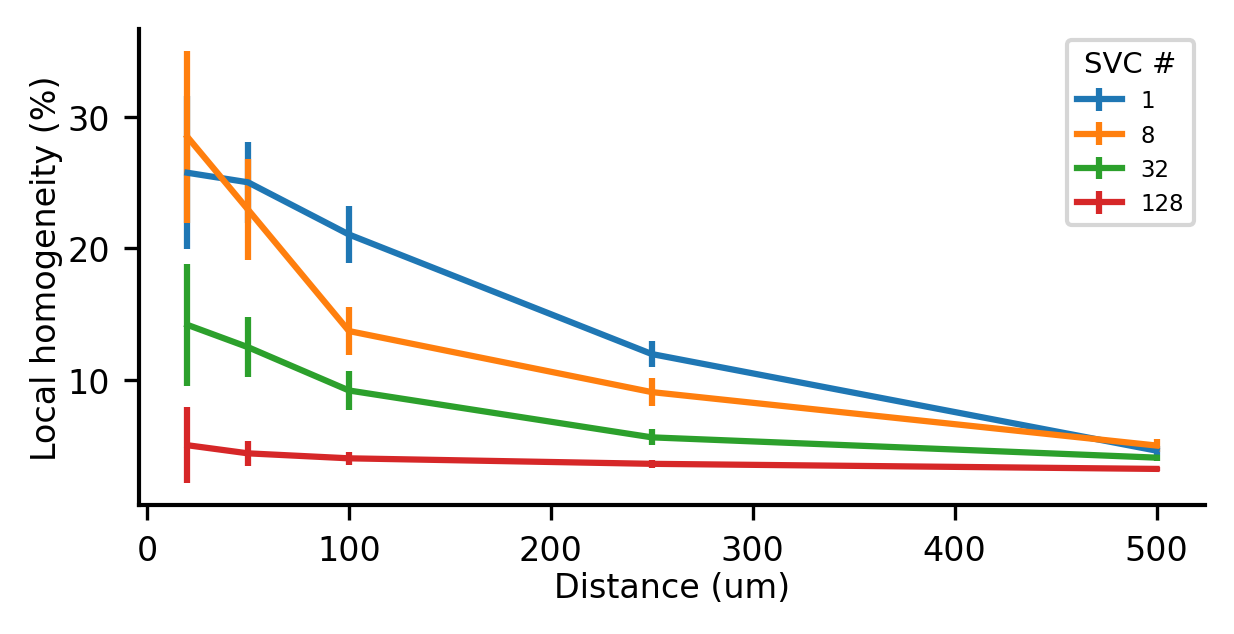
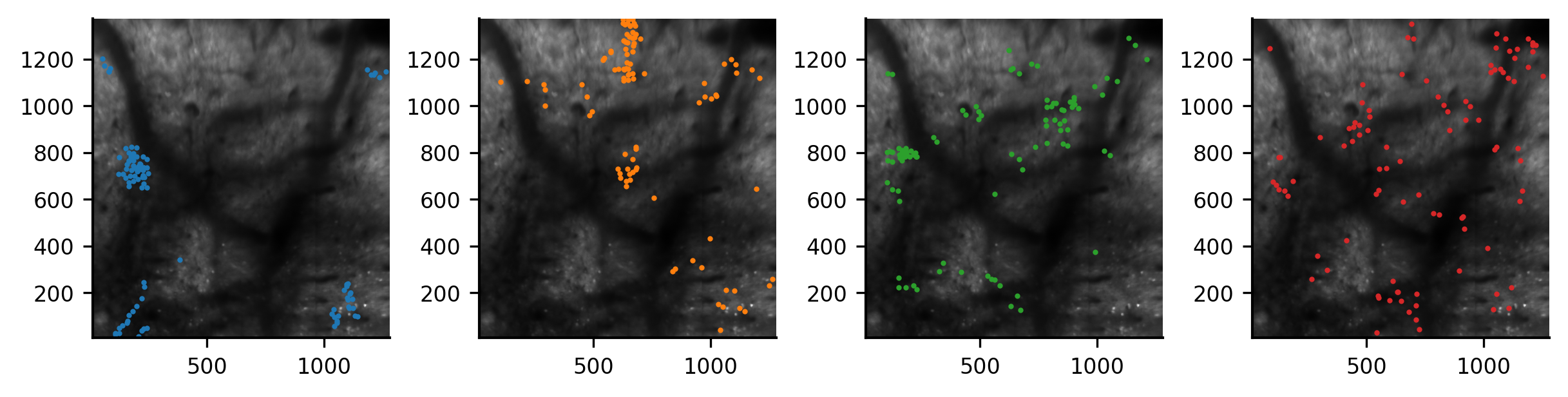
Lower (behavior-related) neural SVCs are spatially clustered
[17]:
svcs_to_plot = [0,7,31,127]

plt.figure(figsize=(4,2))
for i in range(len(svcs_to_plot)):
    hom = np.nanmean(homogeneity[svcs_to_plot[i],:],axis=-1)*100
    ci95 = np.nanstd(homogeneity[svcs_to_plot[i],:],axis=-1)*100/np.sqrt(homogeneity.shape[-1])*1.96
    plt.errorbar(dists,hom,ci95,color=plt.cm.tab10(i))

plt.xlabel('Distance (um)')
plt.ylabel('Local homogeneity (%)')
plt.legend(np.asarray(svcs_to_plot)+1, title='SVC #')
[17]:
<matplotlib.legend.Legend at 0x318f5a3d0>
[18]:
plt.figure(figsize=(8,4))
for i in range(len(svcs_to_plot)):
    plt.subplot(1,len(svcs_to_plot),i+1)
    idxbig = idxsort[:,svcs_to_plot[i]][-int(percentile*u_neurnorm.shape[0]):]

    plt.imshow(expt.Y[:,:,6].T,
               extent=[np.min(centers[0,:]), np.max(centers[0,:]), np.min(centers[1,:]), np.max(centers[1,:])])
    plt.scatter(ucenters[0,idxbig], ucenters[1,idxbig], 1, color=plt.cm.tab10(i))
[19]:
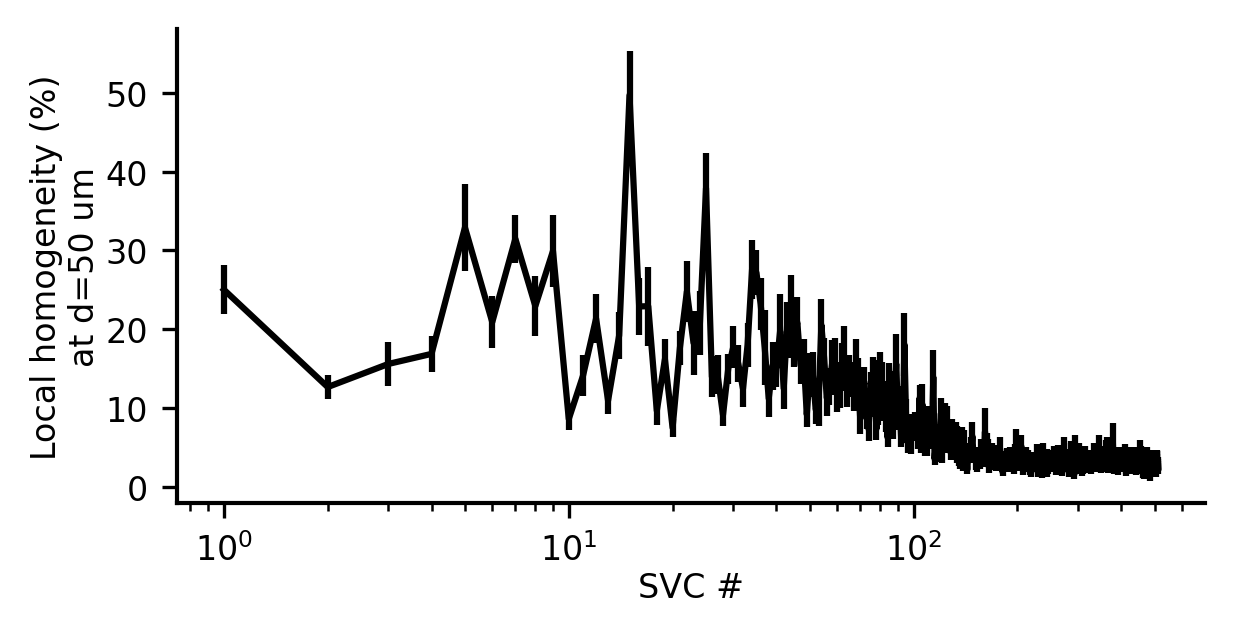
di = 1
hom = np.nanmean(homogeneity[:,di,:],axis=-1)*100
ci95 = np.nanstd(homogeneity[:,di,:],axis=-1)*100/np.sqrt(homogeneity.shape[-1])*1.96

plt.figure(figsize=(4,2))
plt.errorbar(np.arange(homogeneity.shape[0])+1, hom, ci95, color='k')
plt.xscale('log')

plt.ylabel('Local homogeneity (%)\nat d='+str(dists[di])+' um')
plt.xlabel('SVC #')
[19]:
Text(0.5, 0, 'SVC #')
[ ]: